staking
S&P Crypto Index Fund: What Investors Need to Know
S&P crypto index funds are reshaping digital asset exposure. Discover how index-style crypto investing works and where on-chain staking fits in.
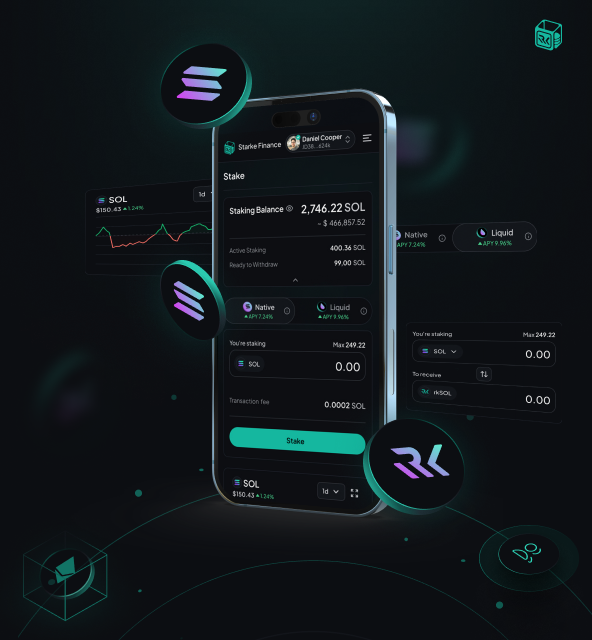
On July 20, 2026, S&P Dow Jones Indices and Pantera Capital launched the S&P Pantera Digital Asset Index (ticker: SPPDA), bringing Wall Street's most recognised benchmark methodology to digital assets. It's a signal that institutional crypto indexing has moved from experiment to infrastructure. But here's the thing: index exposure alone doesn't capture the full return profile of proof-of-stake assets, and sophisticated allocators are starting to notice the gap.
What Is an S&P Crypto Index Fund — and Why Is It Gaining Traction?
The S&P Pantera Digital Asset Index isn't a simple market-cap basket. It draws from the broader S&P Cryptocurrency Broad Digital Asset Index and then applies minimum thresholds for protocol revenue, market capitalisation, and liquidity before a single asset makes the cut. Eligible networks are ranked by aggregate protocol revenue over the prior two quarters and weighted by adjusted market cap. The result: an 18-asset index that looks more like a fundamentals screen than a price-chasing exercise.
The largest constituent is capped at 35%, with remaining assets generally capped at 20% each. Rebalancing happens quarterly. That structure will feel familiar to anyone who's worked with factor-based equity indices; it's rules-based, transparent, and designed to reduce concentration risk without abandoning market-cap logic entirely.
Why is this gaining traction now? Spot Bitcoin ETFs recorded $203 million in daily net inflows in the most recently reported session, part of a six-day streak totalling $930 million (Source: CoinGabbar, August 2026). Total crypto market capitalisation stood at approximately $2.22 trillion as of late July 2026, up 2.30% week over week (Source: CoinMarketCap, July 2026). Institutional demand is real, and index wrappers are the format that compliance teams and investment committees can actually approve.
How Crypto Index Funds Are Constructed — and What Gets Left Out
Index construction in crypto follows a logic similar to traditional passive investing: define the universe, apply eligibility screens, weight by a chosen factor, and rebalance on a schedule. The SPPDA's revenue-and-liquidity methodology is one approach. Bitwise and Hashdex, two of the more established crypto index fund managers, use their own methodologies, with varying treatment of custody requirements and asset eligibility.
What most of these products share, however, is a structural blind spot: native staking yield.
When an index fund holds a proof-of-stake asset like SOL, ETH, or ADA, the fund typically holds spot exposure without activating the staking mechanism. That means the yield generated by delegating those assets to validators, which can be material, simply doesn't flow to investors. An allocator holding SOL through a passive index wrapper may be forgoing staking rewards that a direct or institutionally staked position would capture. The Solana network's average delegator compound APY across epochs 1009–1018 was approximately 3.88% (Source: Validators.app, August 2026). Starke's validator currently delivers a total APY of 5.41% against that network average, with a 0% skip rate and 0% commission (Source: Validators.app, retrieved August 20, 2026).
That's not a rounding error. For a meaningful allocation, the difference between index-wrapped SOL and institutionally staked SOL compounds significantly over a multi-year holding period.
The Yield Layer: Why Validator Infrastructure Changes the Calculus
Think of a proof-of-stake network as having two distinct return streams. The first is price appreciation, which index funds capture. The second is the yield layer: staking rewards generated by validators who secure the network and process transactions. Index funds, almost universally, capture only the first.
Accessing the yield layer requires choosing a validator, and that choice matters more than most allocators realise. Retail staking through a consumer app and institutional staking through a credentialed validator operation are not equivalent products. The differences show up in uptime, commission structure, MEV optimisation, and the security controls wrapped around the operation.
Starke's Solana validator operates with 100% uptime, a 0% skip rate, and 0% commission as of August 20, 2026 (Source: Validators.app). The operation holds ISO 27001 and SOC 2 certifications, the same security standards applied to institutional financial infrastructure. It runs as a Jito-enabled validator, meaning it participates in MEV reward distribution, which contributes to the 5.41% total APY figure above versus the network's average of approximately 5.87% overall APY across all validators (Source: Validators.app, Trillium epoch data, August 2026).
Put simply, institutional staking isn't just about yield. It's about accessing that yield within a framework that satisfies the operational due diligence requirements of a family office or asset manager. Uptime SLAs, audited security controls, and transparent commission structures are table stakes for that audience.
Index Exposure vs. Staked Exposure: A Side-by-Side Comparison
The choice between index exposure and staked exposure isn't binary. Many sophisticated allocators are running both. But understanding the trade-offs across each dimension is essential before structuring a digital asset allocation.
| Dimension | Passive Crypto Index Fund | Direct Spot Holding | Institutionally Staked SOL |
|---|---|---|---|
| Yield | Price appreciation only | Price appreciation only | 5.41% APY + price appreciation |
| Custody model | Fund-level (varies by provider) | Self-custody or exchange | Validator delegation; assets remain on-chain |
| Liquidity | Varies; redemption windows apply | Immediate (exchange-dependent) | Unstaking period applies (~2–3 days on Solana) |
| Regulatory familiarity | High; fund structure is familiar | Moderate | Moderate; improving with audited validators |
| Operational complexity | Low | Low to moderate | Moderate; validator selection required |
| Staking yield captured | No | No | Yes |
For context, Hashdex and Bitwise charge expense ratios on their index products; investors should review current fund documentation for applicable fees. Starke's validator charges 0% commission, meaning delegators receive the full staking reward before network-level inflation adjustments (Source: Validators.app, August 20, 2026).
The honest trade-off: index funds offer simplicity and a regulatory wrapper that institutional investors can deploy quickly. Staking adds yield but introduces validator selection risk, an understanding of slashing mechanics (rare on Solana, but worth understanding), and custody decisions that require more operational infrastructure. Neither approach is universally superior. The question is whether the yield differential justifies the added complexity for a given mandate.
For allocators with meaningful PoS exposure, the answer is increasingly yes. An institutional staking service with audited security controls and transparent performance data removes most of the friction that historically kept institutional capital on the sidelines.
What Institutional Allocators Are Doing in 2026
The emerging institutional playbook treats crypto index exposure and staking allocation as complementary sleeves, not competing strategies. Broad index products handle diversification and regulatory familiarity. A dedicated staking allocation to PoS assets like SOL handles income generation, functioning more like a fixed-income sleeve than a speculative position.
BlackRock, Fidelity, and Franklin Templeton have each expanded their digital asset product ranges in 2026, with tokenised fund structures and crypto ETF offerings continuing to attract institutional capital. The launch of the SPPDA in July 2026 fits this pattern: Wall Street infrastructure providers are building the rails that make institutional crypto allocation operationally viable.
The convergence is worth noting. As index products incorporate more sophisticated methodologies, including revenue-based screens like the SPPDA's approach, and as staking infrastructure becomes more regulated and independently auditable, the gap between "passive crypto exposure" and "active yield generation" will narrow. Validators with institutional-grade certifications and transparent on-chain performance data are already positioned at that intersection.
That said, the gap exists today. An allocator who built a crypto index position in 2024 and never addressed the staking yield question has left real returns on the table. The infrastructure to capture that yield, with the same rigour applied to a traditional fixed-income mandate, is available now.
Explore how Starke's institutional staking infrastructure works, including validator performance data, security certifications, and custody options.
Data as of August 20, 2026. Market conditions change rapidly. All yield figures are subject to network conditions and are not guaranteed. Verify figures at Validators.app and solana.com/staking.
This content is for informational purposes only and does not constitute investment advice. Staking involves risk, including the potential for slashing. Past performance is not indicative of future results.
Contributors

Oscar GarciaFounder & CEO