staking
Secure Staking on Solana: What It Actually Means
Not all Solana staking is equal. Learn what secure staking really requires — from validator uptime to slashing protection — and how institutional infrastructure raises the bar.
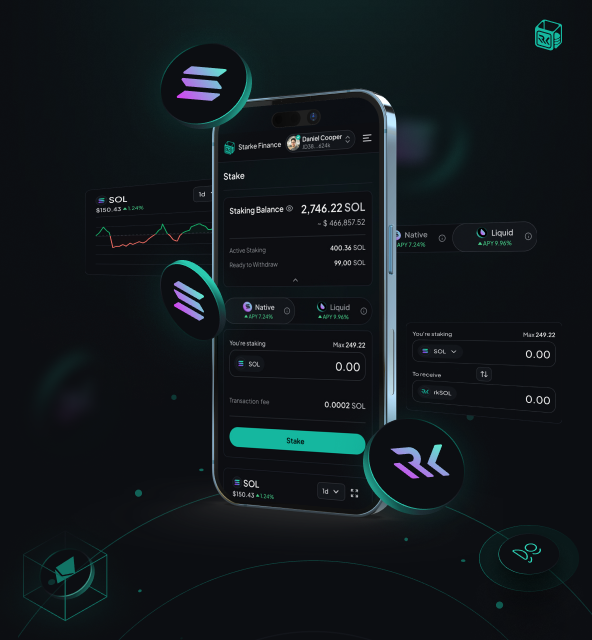
Staking on Solana has never been more competitive. With over 740 active validators on mainnet and institutional capital flowing into the ecosystem, the question is not whether to stake. It is who you trust with your SOL and why. Most providers lead with APY. That is the wrong place to start.
What 'Secure Staking' Actually Means on Solana
Security in staking is not a single feature. It is a stack of operational decisions that compound over time, and most delegators never see the ones that matter most.
Secure staking means your validator is consistently online, voting correctly, managing keys responsibly, and operating with transparent fee structures. On Solana specifically, the consensus model creates some distinct considerations worth understanding.
Solana uses a delegated Proof-of-Stake system where token holders delegate their SOL to validators, who vote on the validity of blocks. Unlike Ethereum's staking model, Solana currently has no slashing mechanism on mainnet (as of April 2026, per Solana Foundation documentation). That means validators cannot destroy your principal through a protocol-enforced penalty. But do not mistake the absence of slashing for the absence of risk. Validators that miss votes, go delinquent, or charge opaque commissions still cost you real money in foregone rewards.
The other critical distinction: delegating directly to a validator is fundamentally different from using a custodial staking platform. When you delegate on-chain, your SOL never leaves your wallet. The validator earns the right to vote on your behalf, and rewards flow back to your stake account. Custodial platforms hold your assets and issue you a receipt. The risk profile is different, and so is the counterparty exposure.
The Five Pillars of a Trustworthy Validator
Evaluating a validator takes about ten minutes if you know what to look for. Here is what actually matters.
Vote performance and skip rate. Every slot, validators are expected to cast a vote. When they miss one, that is a skipped vote. The network average skip rate sits at approximately 2.4% (Source: Validators.app, April 2026). A validator running above that average is costing delegators rewards every single epoch. It is a quiet tax that most people never notice.
Key management. Validators operate three key types: the identity key, the vote account key and the authorization withdrawal key. Best practice separates these, operate the validator in a keyless setup and keeps the authorization withdrawal key in multisignature setup. This eliminates single points of compromise at the most sensitive layer of validator operations. Validators that run hot keys on general-purpose servers are one breach away from a serious operational failure.
Commission transparency. Commission is deducted from staking rewards before they reach delegators. It is set on-chain, which means you can verify it directly on tools like Validators.app. What you should also check is whether a validator has a history of changing commission mid-epoch, a practice that can catch delegators off guard. The on-chain history makes this visible, so take the time to look at past epochs, not just the current rate.
Infrastructure redundancy. A validator running on a single server in a single data center has a single point of failure. Geographic distribution and redundant nodes are not glamorous, but they are what separates consistent uptime from preventable outages. Also it is very common to form a cluster for automated failovers minimizing any potential downtime but also ensuring double active prevention scenario.
Compliance posture. Most validators are anonymous individuals or small teams with no legal accountability. ISO 27001 and SOC 2 certifications require independent third-party audits of security controls. They are not easy to obtain, and they signal a level of operational maturity that self-reported claims simply cannot match.
Starke's Validator Infrastructure: The Numbers Behind the Claim
Starke operates as a Solana validator with institutional-grade infrastructure. The numbers below come from on-chain data as of April 22, 2026.
| Metric | Starke Finance | Network Average |
|---|---|---|
| Total APY | 6.11% | 6.29% (overall avg) |
| Staking APY | 6.00% | 4.46% (avg delegator) |
| Skip Rate | 0.00% | 2.40% |
| Commission | 0.00% | 16.10% |
| Uptime | 100% | N/A |
| Activated Stake | ~200,043 SOL | N/A |
(Source: Validators.app and Solana network epoch data, epochs 950–959, April 2026. SOL price reference: approximately $85.32/SOL during this period.)
A note on the APY figures: Starke's staking APY of 6.00% compares favorably to the average delegator return of 4.46% across the network. The overall network average of 6.29% reflects validators charging commission, meaning their own cut is factored into the total before it is distributed. At 0% commission, Starke passes the full reward to delegators.
A 0% skip rate means every eligible vote was cast. These are not projections; they are on-chain facts.
Starke's staking infrastructure runs with geographically redundant nodes, 24/7 monitoring, and a multisignature withdrawal key authorization policy designed to eliminate single points of failure at the key management layer.
Starke holds both ISO 27001 and SOC 2 certifications, independently audited and publicly verifiable at the Starke Trust Center. These are not marketing badges. They represent documented security controls, tested by third parties, covering everything from access management to incident response. Most community validators have none of this. No legal entity, no audit trail, no accountability if something goes wrong.
How to Evaluate Any Staking Provider Before You Delegate
Whether you are considering Starke or any other validator, the evaluation process should follow the same steps.
Start on-chain. Look up the validator's vote account on Solana Beach or Validators.app. Check the commission history, not just the current rate. Look for delinquency events, which are periods where the validator failed to vote and was temporarily removed from the active set. Solana defines a validator as delinquent when it falls more than 128 slots behind the current slot (per Solana Foundation documentation). Even one extended delinquency event is a red flag worth investigating.
Check the skip rate against the network average. As noted above, the network average sits around 2.4%. Anything consistently above that warrants a question. Anything at or near zero is a strong signal of operational discipline.
Ask direct questions before delegating. A credible staking provider should be able to answer: What is your key management policy? How is the withdrawal key protected? What is your incident response SLA? Are you a registered legal entity? If the answers are vague or unavailable, that tells you something.
Red flags to watch for: commission changes without notice, no public team or legal entity, skip rates trending upward over multiple epochs, and no third-party security audits. These are not hypothetical concerns; they are patterns that show up regularly across the validator set.
For investors considering the rkSOL liquid staking token, or any other liquid stake token the same framework applies. Understand what is underneath the token: which validators are in the pool and how performance is weighted.
Institutional staking differs from retail pools in a few concrete ways. Institutional providers offer formal SLAs, structured reporting, and legal accountability. Retail pools often optimize for yield at the expense of transparency. For family offices or asset managers with fiduciary obligations, that distinction matters.
Secure Staking Is an Infrastructure Decision, Not Just a Yield Decision
Yield is an output. Security is the input. Choosing a validator based on APY alone is like choosing a bank based on its interest rate without checking whether it is insured.
The criteria covered here, including uptime, key management, commission transparency, infrastructure redundancy, and compliance posture, are the inputs that determine whether a validator can sustain its performance over time. A validator running at 100% uptime and 0% skip rate today did not get there by accident. It got there through deliberate infrastructure investment and operational discipline.
The compounding effect of validator reliability is something most delegators underweight. A validator that consistently underperforms the network average by even 0.5% annually costs meaningful yield over a multi-year horizon. Reliability compounds, and so does the opposite.
Starke's approach is to make institutional-grade staking accessible without requiring delegators to manage a node themselves. The certifications, the infrastructure, and the on-chain track record are all publicly verifiable. That is the standard we would encourage every delegator to hold every provider to.
Explore Starke's validator performance data and staking infrastructure in detail.
Data as of 2026-04-22. Market conditions change rapidly. All yield figures are subject to network conditions and are not guaranteed. Verify figures at Stakewiz.com, Validators.app, and solana.com/staking.
This content is for informational purposes only and does not constitute investment advice. Staking involves risk. Past performance is not indicative of future results.
Contributors

Oscar GarciaFounder & CEO